
Why Ritual Still Matters
Modern life treats ritual as outdated, a relic of a less rational age. But from Durkheim to Turner, the evidence is clear: without ritual, society loses its soul.

In our relentless march toward modernity, we’ve placed reason on a pedestal. We’ve celebrated science, rationality, and innovation. And somewhere along the way, we quietly declared war on the seemingly “irrational” myths, symbols, and rituals that once gave human life its shape.
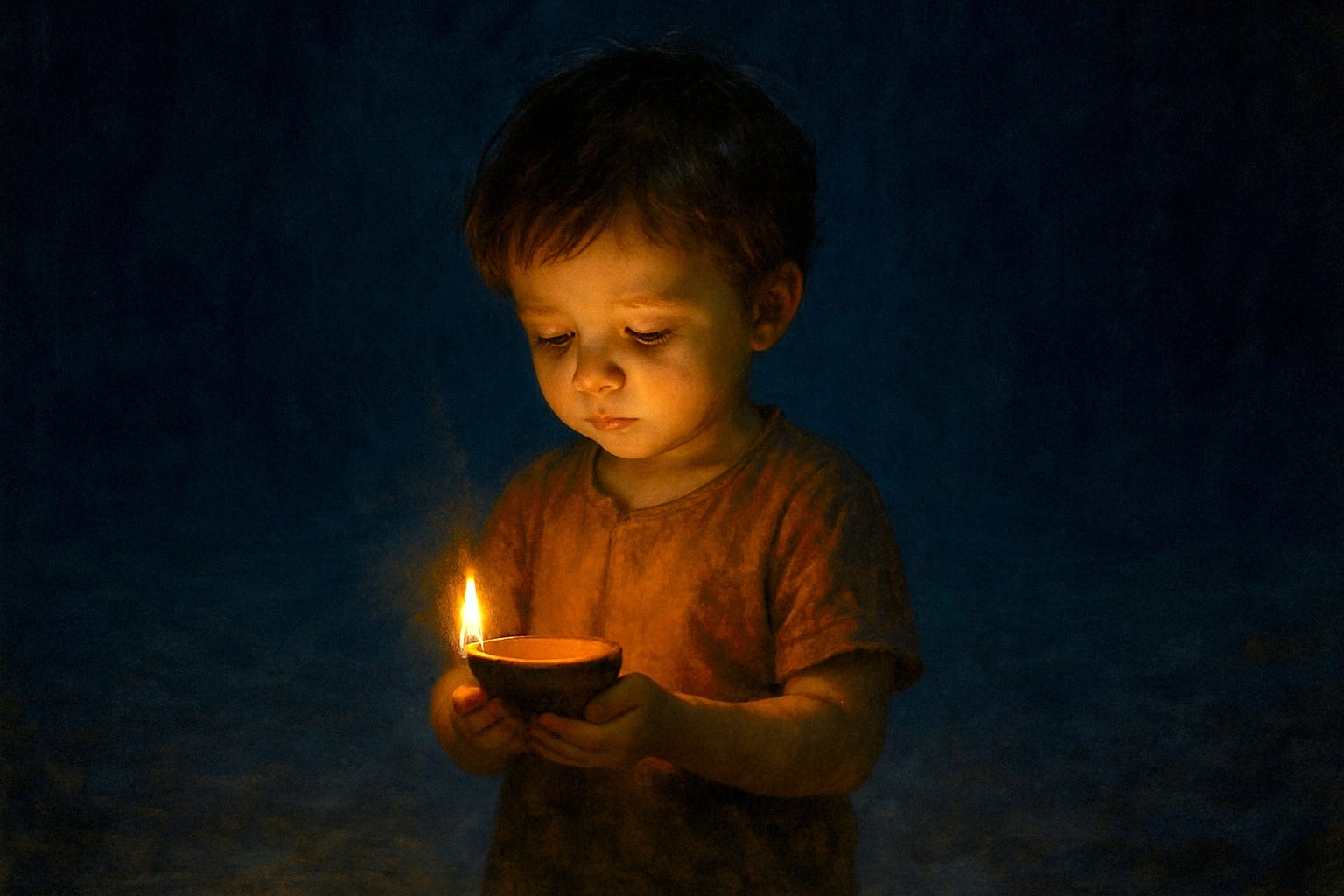
✴️ The Quiet Death of Ritual
Among the first casualties of this modern project have been the intricate, often enigmatic social rituals that have bound human societies for millennia.
Armed with empirical analysis, the “modern” mind dismisses these practices as empty gestures from a superstitious age, devoid of any "scientific" meaning.
We reduce their origins and original purposes to historical curiosities. And when they persist, we treat them as signs of societal inertia rather than intention.
But here lies a profound and unsettling truth:
The more we strip away these rituals, the more we find ourselves adrift in a sea of meaninglessness, cut loose from the very anchors that give our collective and individual lives meaning and structure.
Dismissing ritual as obsolete isn’t just a philosophical error. It’s a sociological blunder of the highest order.
Of course, we must critically examine and discard rituals that perpetuate injustice or are widely perceived (rightly or wrongly) as doing so, or are truly obsolete. But to abandon the ritualistic dimension of human life altogether is to dismantle the very architecture of society itself.
⚡ The Social Function of Sacred Acts
One of the foundational giants of modern sociology, Émile Durkheim, helps us understand why rituals matter.
In his seminal work “The Elementary Forms of Religious Life”, Durkheim wasn’t concerned with whether religion was “true” in a theological sense. His focus was on its social function.
He argued that collective rites serve one primary purpose:
They periodically reaffirm a group's identity and moral foundation.
Durkheim drew a fundamental distinction between the “sacred” and the “profane”.
The “sacred” includes things we treat as special and important: things we handle with care, respect, and ceremony. They might be religious, but don't have to be.
The “profane” is everything else: the everyday, the practical, the disposable.
According to him, societies define what is “sacred” in order to express what they most value and fear losing.
This sacred-profane divide creates boundaries between "mere existence" and "what matters, what has meaning, what binds us together."
Rituals are the practices that help maintain these boundaries, reinforcing what the group holds sacred.
This distinction, Durkheim argued, forms religion's core.
Religion is not just about gods or supernatural beings. It is a social institution that binds people together. It creates meaning and cohesion by delineating what is sacred from what is ordinary.
Even non-religious people treat certain things as “sacred”. Think about how we handle national flags, funerals, or important historical moments.
For Durkheim, rituals are the mechanisms through which a community engages with the sacred.
When a clan, tribe, or congregation comes together for a ceremony, they are not merely worshipping a deity. They are, in a profound sense, worshipping themselves, the idealized version of their collective identity.
This process generates what Durkheim famously termed “collective effervescence.”
In these moments of heightened communal activity, individuals feel a powerful, transcendent energy that lifts them out of their profane, individualistic existence and fuses them into a single, cohesive whole, their shared beliefs and values flowing through the group like electricity.
We see this when thousands sing the national anthem in a stadium, during shared moments of silence, or at community festivals. These are modern, secular manifestations of the same phenomenon. They’re sacred in everything but name.
From this perspective, asking for the “scientific” meaning of a ritual is asking the wrong question entirely. Its meaning is not empirical but symbolic and social.
Its function is to create solidarity, to remind individuals that they are part of something larger and more enduring than their own fleeting lives. It is the social glue that prevents society from dissolving into a mere collection of self-interested individuals.
🚪 Navigating Life's Dangerous Passages
Building on this, the anthropologist Victor Turner illuminated the crucial role of rituals in navigating the inevitable transitions of life.
His work on “rites of passage” (ceremonies marking birth, coming of age, marriage, and death) revealed a universal three-stage structure:
Separation, liminality, and incorporation.
The middle stage, the liminal phase, carries the most sociological weight. In this in-between state, the individual is stripped of their previous social status and exists in ambiguity. They are neither child nor adult, neither single nor married. It’s a period of vulnerability but also immense potential.
During this liminal phase, individuals often experience what Turner called communitas, an intense, egalitarian bond with others undergoing the same transition.
Think of the shared experience of boot camps, spiritual retreats, med school cohorts, or the traditional seclusion of initiates.
These are liminal spaces where the normal hierarchies of the “profane” world are suspended.
The rituals governing these periods (the specific trials, teachings, and shared hardships) are not arbitrary. They are carefully designed to break down the old self and forge a new identity, one that is deeply inscribed with the values and expectations of the community.
When individuals are finally reincorporated into society with their new status, they’re not just older or more skilled. They are fundamentally changed. Their personal transformation is inseparable from the collective.
These rituals provide a clear, socially recognized path for growth and change, shielding us from the existential dread that so often accompanies life’s major transitions. Without them, we’re left to reinvent meaning at every stage of life, alone, unguided, and often overwhelmed.
📖 Living Stories We Tell Ourselves
The argument that the origins of rituals are irrelevant finds strong support in the work of symbolic anthropologist Clifford Geertz.
Geertz viewed culture as a system of inherited conceptions expressed through symbolic forms, and rituals as a primary “text” in which these conceptions are articulated.
For Geertz, a ritual is a story a society tells itself about itself.
A Balinese cockfight, in his famous analysis, wasn't just about gambling. It was a dramatic enactment of the complex web of status, rivalry, and social alliances that constituted Balinese society. Participants and observers were, in effect, reading the symbolic text of their own culture.
This means that the power of a ritual lies in its contemporary performance and interpretation, not in its historical fidelity.
A ritual persists not because of its ancient origins, but because it continues to resonate with the current worldview and emotional life (the "ethos") of a community. It is a marker of continuity, yes, but it is a living continuity.
Each generation subtly reinterprets and adapts these performances, infusing them with new meanings while retaining a core that connects them to the past.
Therefore, to be overly concerned with “who created a ritual or why” is to treat it like a dead artifact in a museum. Its vitality comes from its use, from the way it continues to provide an "anchoring for people" in the here and now.
⚔️ The Conflict Theory Challenge
Of course, this defense of ritual isn’t without its critics. And some of the strongest come from the conflict theory tradition, most notably Karl Marx.
For Marx, the dominant ideas of any epoch are the ideas of its ruling class. From this perspective, many rituals are not benign tools of social cohesion but sophisticated instruments of ideological control. They are part of the “superstructure” that legitimizes the economic “base” of exploitation.
It is undeniable that certain rituals have been exclusionary and oppressive or at least perceived as such, particularly after the Industrial Revolution, when the fundamental nature of society underwent a profound transformation.
These criticisms matter. Blindly defending all rituals would be just as naive. However, they do not invalidate the fundamental sociological importance of the ritual form itself.
Before offering a counterargument, it’s worth noting that criticism from conflict ideologies is often rooted in an absolutist framework that views all social structures as inherently oppressive.
This framing overlooks the functional and symbolic dimensions of ritual, reducing everything to power dynamics alone.
The goal of many ideologies grounded in conflict theory is not merely justice, but power and retaliation. While many sincere adherents believe they are advancing equality, the logic of these movements often trends toward totalizing binaries: you're either an oppressor or you're oppressed, with no room for nuance. Rather than working to end oppression entirely, these ideologies often aim merely to invert the power structure.
Take deconstructionism, for instance. While it offers sharp critiques of meaning and authority, it rarely provides constructive alternatives. Though it presents itself as a neutral critique, it often functions as a strategy of endless destabilization. The result is not reform, but perpetual deconstruction.
And in a world already fragile with isolation and meaninglessness, we don’t need more tearing down. We need frameworks that can hold us together.
🏺 The Vessel and Its Contents
My counterargument has two parts.
First, the problem is not with ritual, but with the values a specific ritual encodes. A ritual is a vessel. It can be filled with poison or with nectar. The task for a healthy society is not to smash all the vessels but to be vigilant about what we pour into them.
Second, the belief that we can live in a purely rational, ritual-free society is a utopian fantasy. The ritualistic impulse is too deeply embedded in the human psyche. When old rituals fade, new ones inevitably arise to take their place, often in secular forms.
The obsessive fandoms of professional sports. Corporate retreats. “Self-care” routines. Hashtag outrage mobs.
All these are modern rituals, sometimes meaningful, often hollow, serving the same ancient hunger for structure, belonging, and transcendence.
The danger is that these substitutes (often commercialized or politically driven) lack depth. They give us flashes of connection, but are far less effective at creating genuine, lasting communitas, the durable bonds that traditional rituals once offered.
🧱 Ritual and the Human Condition
The modern dismissal of ritual is a profound misreading of the human condition. While we must remain fiercely critical of any tradition that perpetuates harm, we must also recognize that the structure of ritual is as essential to a society as beams and joists are to a house.
They’re not ornamental. They’re the load-bearing walls of our collective identity.
Durkheim showed us how rituals forge solidarity. Turner showed us how they carry us through life’s chaos. Geertz showed us how they tell us who we are.
To see rituals as meaningless because they lack "scientific" validation is to fundamentally misunderstand their purpose.
Their meaning is social, emotional, and symbolic.
They are the architecture of the soul, providing the continuity and anchoring that we desperately need in a world of dizzying change.
In tearing down the scaffolding of ritual, we thought we were freeing ourselves. But perhaps we were just unmooring the boat and cutting the rope.
Feel free to share your thoughts in the comments. I'd love to hear how ritual shows up in your life, or where you think we’ve gone astray.
The article touches all the right notes highlighting objectives and benefits of rituals. I am afraid desacralising of rituals is encouraged specifically because they know the power of rituals and want to tear them down. The points raised in the article will be useful as a justification more for those who still want to hold on those rituals than to rebut those who want to tear them down.
Superbly written! Although, the spiritual aspect of rituals also needs to be explored. Logic / emphericism has it's place, no arguments there, but they aren't universal parameters. Once again, extremely well written, kudos.